
ADHD Wise Squirrels Podcast · Episode 83
Channel 4’s Irresponsible ADHD Documentary, Misinformation, Understanding Perimenopause and Menopause.
EPISODE SPONSORED BY: Inflow. Inflow helps people make sense of how ADHD traits show up in their own lives, then points them toward the support that’s right for them. For some people, that means practical CBT-based tools in the Inflow app. For others, it may mean connecting them to specialized ADHD therapy through one of Inflow’s trusted partners. Take Inflow’s free ADHD traits quiz at wisesquirrels.com/inflow.
Please let Channel 4 know your thoughts on their harmful “The Great ADHD Myth?” documentary. Such misinformation will only do us harm and further stigmatize people with ADHD. CONTACT CHANNEL 4.
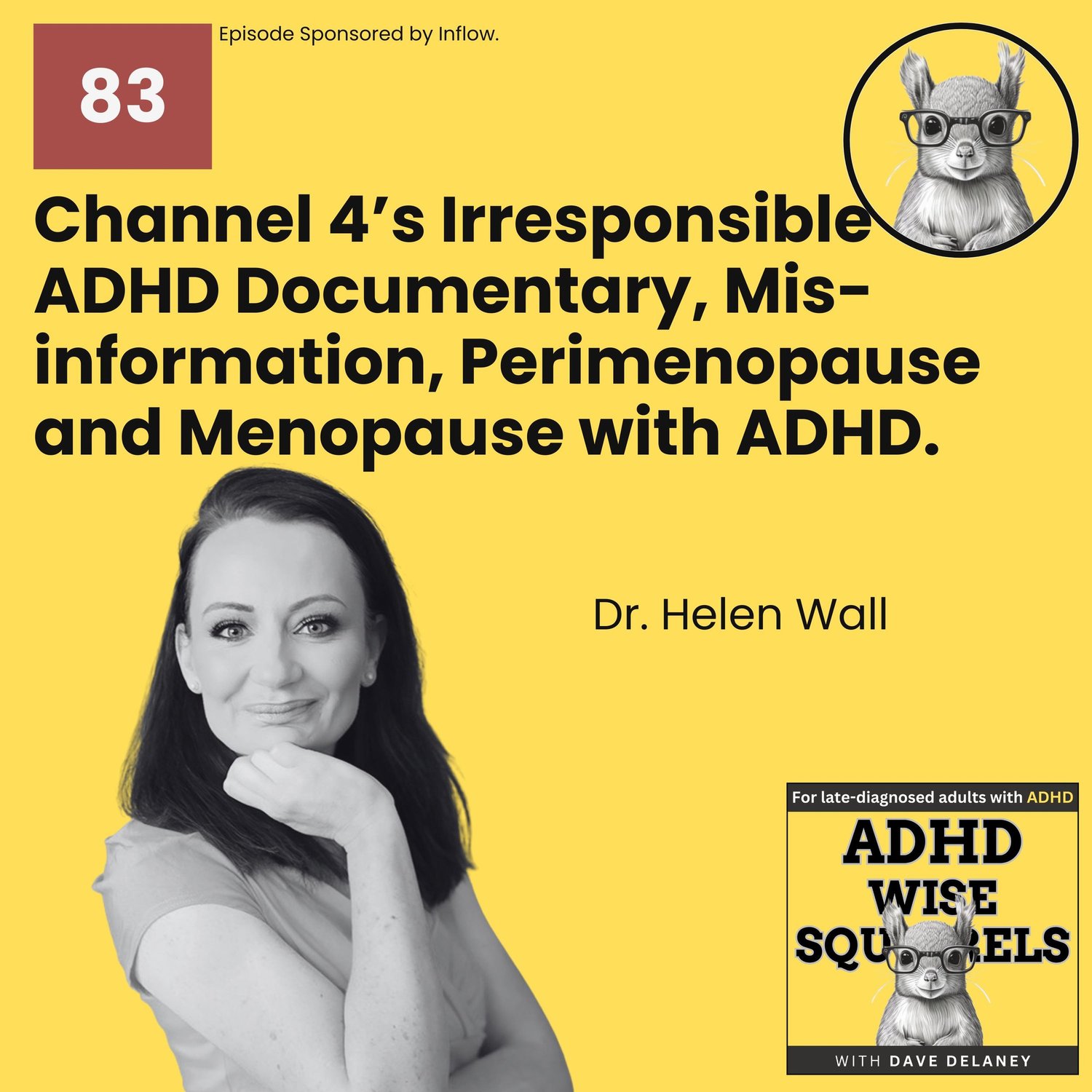
Dr. Helen Wall is a physician, author, and speaker whose work focuses on the intersection of female hormones, brain health, and neurodiversity. She is the author of the groundbreaking book Menopause and ADHD: How to navigate hormone flux and neurodivergence, exploring the connection between menopause and ADHD and bringing attention to the often-overlooked impact hormonal changes can have on women’s cognition, mood, focus, and well-being.
Through her clinical work, research interests, and public advocacy, Dr. Wall is helping reshape conversations around women’s health by highlighting how fluctuations in hormones across the lifespan can affect the female brain. She is particularly passionate about improving awareness, diagnosis, and support for women navigating ADHD during perimenopause and menopause, and she is a leading voice in bridging the gap between neuroscience, mental health, and hormonal medicine.
Dr. Helen Wall on ADHD, Perimenopause, and Media Misinformation
Guest Profile: Dr. Helen Wall
- Clinical Experience: Senior UK NHS General Practitioner with over 20 years of clinical experience, Clinical Director, and Visiting Professor.
- Specialization: Accredited menopause specialist with the British Menopause Society.
- Media & Author: Resident doctor on BBC Breakfast, columnist for Woman Magazine, and author of Menopause and ADHD.
Episode Highlights
- Exposing Channel 4’s Misinformation: Dr. Wall and host Dave Delaney critique the controversial Channel 4 documentary The Great ADHD Myth? They dismantle its scientifically inaccurate claims, including the misrepresentation of MRI scan data to deny ADHD's biological reality and condemn the presenter's performative on-camera consumption of stimulant medication. The widely criticized Channel 4 documentary about ADHD is hosted by NHS psychiatrist Dr Max Pemberton. Broadcast in August 2026, the 60-minute film alleges to investigate the sharp rise in ADHD diagnoses and questions whether the condition is a biological brain disorder or a social construct.
- The Case for ADHD Medication & Real-World Risks: Why prescription stimulants are a vital component of treatment rather than a "quick fix". The episode highlights research showing untreated ADHD can reduce life expectancy by up to 13 years due to addiction, driving impulsivity, suicide, and severe burnout, underscoring how diagnosis provides life-saving validation and care.
- Perimenopause, Menopause, and Neurotransmitters: An in-depth look at female sex hormones. Declining estrogen during perimenopause destabilizes dopamine, serotonin, and norepinephrine pathways, causing high-functioning women's lifelong coping mechanisms and masking strategies to suddenly disintegrate.
- Unmasking vs. Midlife: Clarifying that ADHD is a lifelong neurodevelopmental condition present from birth, not something triggered by midlife changes. Dr. Wall explores how perimenopause unmasks underlying traits, highlighting the 80% overlap with Premenstrual Dysphoric Disorder (PMDD) and how clinicians differentiate ADHD from perimenopause's 40+ linked symptoms.
- Hormone Treatment & Multimodal Care: The clinical rationale for Hormone Replacement Therapy (HRT) to help stabilize midlife hormonal fluctuations and support executive function. The discussion outlines a multi-faceted management strategy combining HRT, high-protein nutrition to prevent glucose crashes, ferritin monitoring, and practical advice on vetting GPs and family doctors for neurodivergence awareness.
Patient Resources
- Clinical Guidance: Women's Health Concern (British Menopause Society patient section). https://www.womens-health-concern.org/
- Connect with Dr. Wall: Visit https://drhelenwall.com/ and follow @doctorhelenwall.
Transcript
The whole program was really disappointing. It wasn't an investigation at all by any stretch of the imagination. It was very one-sided.
0:088 secondsIt had a narrative. Everybody they spoke to, every expert that they chose to speak to had the view that ADHD is not real and that's what was carried
0:1616 secondsthroughout the whole show. There was no counterbalance to it. There was no evidence brought to it. I felt it was a huge misrepresentation of uh what information and evidence we do have.
0:3636 secondsWelcome to Wise Squirrels, the podcast for late diagnosed adults with ADHD. I'm your host, Dave Delaney.
0:4545 secondsOh, wow. I've got a big interview for you today. Uh this is just on the heels
0:5151 secondsof a documentary on Channel 4 in the UK which has created quite a stir in our
1:001 minutecommunity because of the false claims and misinformation that concludes that ADHD is a myth. And who else to have on
1:091 minute, 9 secondsthe podcast to discuss this channel for garbage is Dr. Helen Wall, who is a
1:161 minute, 16 secondsphysician, author, speaker, and she specializes in the intersection of female hormones, brain health, and
1:241 minute, 24 secondsneurodeiversity. She's the acclaimed author of the groundbreaking book menopause and ADHD. For the first chunk
1:321 minute, 32 secondsof this interview, we'll be discussing the Channel 4 documentary, factchecking some of it, um, and just sharing why
1:421 minute, 42 secondsthis will ultimately do more damage than it will help anyone. In addition, if you've ever had questions, and I had
1:501 minute, 50 secondsquestions about menopause and pmenopause and ADHD's effect on women during these
1:581 minute, 58 secondsperiods of their lives, we get into this topic deeply, and it's often misunderstood and it's something more
2:062 minutes, 6 secondspeople should understand. And not just women, of course, if you're married to one, if you have daughters, mothers, aunts,
2:152 minutes, 15 secondsthe women in your life. Um, I think it's extremely important for everybody to listen up and pay attention and
2:222 minutes, 22 secondsespecially for the women who really need to understand the symptoms and and understand pmenopause because this is
2:302 minutes, 30 secondssomething, you know, I mentioned before a period of your life. This is something that can last between like five and 10 years and uh so it's important to
2:392 minutes, 39 secondsunderstand especially with ADHD. So this is an important episode today and it's a timely one given channel 4's recent um garbage.
2:502 minutes, 50 secondsIf you haven't checked out inflow yet, it's a perfect place to go and take their free ADHD traits quiz which is available at wisquirrels.com/inflow.
3:023 minutes, 2 secondsThe quiz will give you uh results that will help direct you into some immediate
3:093 minutes, 9 secondssteps that you can take to improve uh your life including productivity and and things like that and also teach you
3:173 minutes, 17 secondsabout the uh tendencies associated with your presentation of ADHD. Take that
3:253 minutes, 25 secondsfree quiz now at wisquirrels.com/inflow and follow along. And I think you're going to find some great steps to help.
3:343 minutes, 34 secondsI should add, by the way, that Inflow uh was co-founded by Dr. George Sax, a former guest on the podcast. He's a
3:433 minutes, 43 secondsclinical psychologist, and he spent over 15 years specializing in ADHD, and he's a fellow wise squirrel, and he built
3:523 minutes, 52 secondsInflow to help you decode exactly how ADHD shows up in your specific life. and then inflow points you directly toward
4:014 minutes, 1 secondthe support that best fits you. Check it out. I'm Dr. Helen Wall. I'm a GP by trade.
4:104 minutes, 10 secondsSo, uh, for people listening who aren't in the UK, I suppose that would be a family decision. Um I have done that for
4:184 minutes, 18 secondsaround about 20 years but I've also always had a massive passion for women's health and I've done plenty of things in my career uh with women's health and
4:254 minutes, 25 secondslatally I I became a menopause specialist with the British Menopause society uh a few years ago and um yeah I
4:334 minutes, 33 secondsdo a lot of work in the ADHD community because I uh had my own personal experience with my daughter being diagnosed with ADHD and I was seeing
4:404 minutes, 40 secondslots of women who I felt were having a lot of hormonal impact from uh from hormonal changes and that were impacting
4:484 minutes, 48 secondson neurody divergence. So yeah, that's that's sort of the bulk of my work now is seeing women in hormonal flux with uh
4:544 minutes, 54 secondsADHD and I wrote a book about that uh which came out earlier this year in May.
5:005 minutesSo I guess you could say I'm an author as well although that always still sounds a little bit weird to me.
5:065 minutes, 6 secondsNo, congrats. I mean, it's a I I have written a published book and it's it was hell, especially writing it undiagnosed
5:135 minutes, 13 secondswith my ADHD uh before I knew I had ADHD. That that made it even more challenging. So, congrats on on the
5:195 minutes, 19 secondsbook. And it's called and ADHD. So, I think uh it's spot on. And as we were talking about before, this is a topic um
5:275 minutes, 27 secondsthat has come up a lot. You know, statistically speaking, and you can always correct me where I'm wrong, women are typically diagnosed about five years
5:355 minutes, 35 secondsafter men. You know, I talked about this a lot on the podcast before, so we don't have to dwell on the the reasons why, but I would rather focus more on on the
5:445 minutes, 44 secondssubject of ADHD and menopause and pmenopause and how these how this affects ADHD in women, diagnosed or
5:525 minutes, 52 secondsundiagnosed, treated or untreated. But before we go there, I do also want to talk about the Channel 4 documentary
6:026 minutes, 2 secondsabout ADHD, which I will admit I haven't seen yet, which just came out recently.
6:076 minutes, 7 secondsSo, Channel 4 is a usually at least a wellrespected uh at least in my opinion.
6:136 minutes, 13 secondsUh they've always produced quality programs and things. Um, but Channel 4 is a big deal there and just produced
6:226 minutes, 22 secondsand and released this documentary making some pretty bold claims about ADHD. So, I was hoping we could kind of dig into some of that. Where to begin?
6:326 minutes, 32 secondsSure.
6:336 minutes, 33 secondsYeah. I mean, I don't think I'm alone uh in in saying that, you know, this week's been tough with that show. Really tough
6:426 minutes, 42 secondsuh for the ADHD community. it we we were given the heads up that this show was going to air a few weeks ago and there
6:496 minutes, 49 secondswas a lot of upset then amongst uh the ADHD community because I think the very title of it uh you know just just sort
6:576 minutes, 57 secondsof was diminishing really it said you know AD for those that don't know it was ADHD the myth question mark um and that
7:057 minutes, 5 secondsalready you know caused some upset because I see a lot of late diagnosed ADHD women or even undiagnosed still in their 40s and 50s experiencing in
7:137 minutes, 13 secondspermenopause and menopause and uh you know they are really struggling to to
7:217 minutes, 21 secondsget that validation and the answers that they've been reaching for all their lives as you as you will well know Dave and what this did basically even with
7:307 minutes, 30 secondsthe very title of it was sort of invalidate many many people with ADHD so Channel 4 came back to the criticism the
7:387 minutes, 38 secondspre-criticism even before the show was aired to say that this was going to be a science-led investigation into whether you know whether ADHD the ins and outs
7:467 minutes, 46 secondsof ADHD and what the evidence for it was etc. So I watch this with an open mind I like to think on Tuesday evening. Uh I I
7:547 minutes, 54 secondsI I work in the media a lot and I am always conscious of not criticizing or speaking out against other clinicians
8:028 minutes, 2 secondsthat or experts that are in in the media without you know knowing the full story because often things can be taken out context or things can be um you know
8:118 minutes, 11 secondsedited to to to build one view. But I have to say the whole program was really
8:208 minutes, 20 secondsdisappointing. It wasn't an investigation at all by any stretch of the imagination. It was very one-sided.
8:258 minutes, 25 secondsIt had a narrative and it was there to put the just just everything that everybody they spoke to, every expert
8:338 minutes, 33 secondsthat they chose to speak to had the view that ADHD is not real. And that's what was carried throughout the whole show.
8:398 minutes, 39 secondsThere was no counterbalance to it. There was no evidence brought to it. I felt it was a huge misrepresentation of uh what information and evidence we
8:488 minutes, 48 secondsdo have uh that ADHD is real and and I've let Channel 4 know that for what it's worth. Probably not a lot. Um but it's caused it's caused a lot of upset
8:568 minutes, 56 secondsand there's I've been contacted by loads of people, women. I've got a quite a large social media community over
9:049 minutes, 4 seconds200,000 women and and the number of people that have reached out and said that they are feeling really quite um invalidated, dismissed and just really
9:139 minutes, 13 secondssort of unwell really many of them after that program.
9:189 minutes, 18 secondsYeah, it's such a shame. I mean what I've learned in my experiences um you know and something I've echoed a lot
9:269 minutes, 26 secondshere is that there's um Dr. Russell Barkley who's, you know, a well- reggarded uh physician and researcher,
9:349 minutes, 34 secondsnow retired in the space, who dedicated decades to the work and to this topic, came out and said a while back that with
9:429 minutes, 42 secondsundiagnosed and untreated ADHD, your life expectancy can be up to 13 years less.
9:519 minutes, 51 secondsYeah. And there's other studies that show like seven or eight years less. But regardless, those are lifespans that are
9:579 minutes, 57 secondslessened from not getting diagnosed and treated in whatever ways that the treatment is, whatever you need. Women
10:0510 minutes, 5 secondshave often been missed at least and correct me where I'm wrong because they tend to be and not always of course but
10:1210 minutes, 12 secondsthey tend to be more of the inattent inattentive presentation of ADHD predominantly inattentive which means
10:1910 minutes, 19 secondsthat they're not diagnosed earlier because they're not disrupting the class like the hyperactive boy running around aka Dave Delaney. [snorts] Um and so
10:2810 minutes, 28 secondsthey're missed and then as they get older uh they start to develop anxiety or depression which are the most common
10:3510 minutes, 35 secondscoorbidities that come along or can come along with ADHD and subsequently they're treated for the anxiety or depression never being never identifying or
10:4410 minutes, 44 secondstreating the ADHD and thus never really addressing the root cause of that or at least part of the root cause of that
10:5110 minutes, 51 secondsanxiety and depression and that that 13-year lifespan. and short shortage or
10:5810 minutes, 58 seconds[laughter]
10:5910 minutes, 59 secondsshortening. Yeah, shorting. Thank you. Apparently, I can't speak today. Part of [snorts] that accounts for, you know, h uh it
11:0711 minutes, 7 secondsimpulsivity. So, like if you're driving and you're not aware you have ADHD or you're not treated for it, you could drive dangerously, make a lane change
11:1511 minutes, 15 secondsreally quickly without looking. It just impulsive and suddenly cut somebody off and and kill yourself or kill someone else. And then the other side of it is
11:2311 minutes, 23 secondsis the addict our nature for you know are prone to addictions and excess um which uh also account couldn't
11:3111 minutes, 31 secondsaccount for that and then also uh suicide and so that all said it's not just like oh misinformation about ADHD
11:4011 minutes, 40 secondsit's this is this is it's really damaging. Yeah, it's really damaging and I don't feel like Channel 4
11:4811 minutes, 48 secondshave really acknowledged that. They have obvious they've had a lot of offcom complaints. They've had a lot of um contact with them. You know, lots of people have written in, have signed
11:5611 minutes, 56 secondspetitions and um I having worked in the media for a while, I dropped the commissioner for Channel 4 a line and
12:0412 minutes, 4 secondsjust said, you know, I was really disappointed.
12:0712 minutes, 7 secondsum I feel like you misrepresented the information, the medical information and you know the response was well um
12:1512 minutes, 15 secondswe've got a right to be polarizing you know we can polarize views that's okay and I think absolutely you know and I think what's happened now in the UK over
12:2312 minutes, 23 secondsthe last couple of days is there's been sort of a push back to the push back if you like on the show to say you know a people with ADHD don't want to they
12:3112 minutes, 31 secondsdon't want to to be challenged and we don't want any critique and that's absolutely not the case. You know, there are so many things we can debate about
12:3812 minutes, 38 secondsADHD. In the UK, we've got a huge debate about the providers that are assessing this. You know, there's a been a huge rise in providers, a lot of them private
12:4712 minutes, 47 secondsproviders. There's not necessarily a standardized assessment, you know, protocol, etc. Um, you there's lots of
12:5412 minutes, 54 secondsthings we can debate about ADHD and how we manage it and how we assess for it.
12:5912 minutes, 59 secondsUm, but what we really shouldn't be debating is whether it is real. And that was the issue that I took with this program. And the the doctor that
13:0813 minutes, 8 secondsactually um narrated the program that went to interview people and met with other experts and I you know I have my other things to say about that.
13:1713 minutes, 17 secondsUm he actually said at the end of the program, I now know that ADHD is not real. It basically it's now confirmed
13:2413 minutes, 24 secondsfor me that ADHD is not real. and um you know that is so and and there were multiple things within the program when
13:3113 minutes, 31 secondsyou watch it Dave that you'll see is uh that he was basing that on that I just don't think as a as a qualified doctor
13:3913 minutes, 39 secondsand registered professional you should be basing your information on foric and I'll just give I won't spoil it for you but I'll just give you one example so
13:4613 minutes, 46 secondsoh you could spoil it go yeah yeah he uh he went um he went to meet with somebody in London who uh you know
13:5413 minutes, 54 secondssomebody who does all the imaging and talks a lot about MRI scans and brain imaging and she quite clearly said and this bit was kept in the program she's
14:0214 minutes, 2 secondscalled Dr. Katia she said um you know there's no one thing on a brain scan that we can say that person has ADHD but at population level we know that there
14:1114 minutes, 11 secondsare changes in brains that are different in those with ADHD than those without but no we can't you know take somebody through put somebody through a scanner
14:2014 minutes, 20 secondsand say oh look they've got this feature so they've got ADHD he completely ignored the bit about oh at population level there are changes and there are
14:2914 minutes, 29 secondsdifferences in how the brain functions and we know this which is she clearly said and then he walked out of that room and said, "So there's no definitive
14:3614 minutes, 36 secondstest. So therefore, how can ADHD be real?" And I've got a couple of issues with that. One, he mis misrepresented what she'd said quite clearly and misrepresented the medical information.
14:4614 minutes, 46 secondsBut two, there are so many conditions that we haven't got definitive tests for that we can still that we still accept
14:5314 minutes, 53 secondsand still manage and still actively seek out and support people for, you know, migraine, Parkinson's disease, irritable bowel syndrome. and he's a consultant
15:0215 minutes, 2 secondspsychiatrist. He's a psychiatry specialist. And I would really argue, you know, what there's so many
15:1015 minutes, 10 secondsconditions in psychiatry that don't have definitive tests. Anxiety, depression, bipolar disorder, eating disorders. What definitive test is he using for all
15:1815 minutes, 18 secondsthose conditions? And why is AD why has he singled out ADHD as not being real?
15:2315 minutes, 23 secondsBecause there's no definitive test, you know? And then he got into this situation where he basically said I don't believe I can't remember whether
15:3115 minutes, 31 secondshe said it wasn't very clear whether he felt he didn't have ADHD or he had ADHD but he felt it didn't impair him and he went basically and had an assessment a
15:3915 minutes, 39 secondsprivate assessment which they semifilmed but he didn't get to really see what the answers and so on were and then uh he was quite quickly given
15:4715 minutes, 47 secondscontrol the amphetamus elvance or stimulant control drug and he took it on television. So, you've got a doctor here
15:5415 minutes, 54 secondswho is saying, you know, I'm a specialist in this area. I don't believe this condition exists. Uh, I've
16:0216 minutes, 2 secondsundergone my own private assessment and I've been given this controlled drug and now I'm and I and I don't think that's right. I don't think I should be taking this, but I'm going to take it. And then
16:1016 minutes, 10 secondshe took it and was quite what I would describe as performative, almost mocking of those people with ADHD. He was very like, you know, oh, I feel really woo
16:1816 minutes, 18 secondsand and you know, this is what it makes you feel like. And there's so many. It was so uncomfortable to watch and I
16:2416 minutes, 24 secondsthink I was watching it with my medical head on of 20 years but also as a mom of uh somebody you know who has been
16:3316 minutes, 33 secondsthrough a terrible journey with ADHD and we've just about got on the better side of you know more than likely I've got ADHD myself but you know we've not gone
16:4116 minutes, 41 secondsthere and I just felt like I felt really sad for for those women and I'm going to
16:5016 minutes, 50 secondssay women cuz I see women that's who that's my uh people who I see and work with who've spent their whole lives
16:5716 minutes, 57 secondsnot understanding why they struggling or why they can't keep up or why they're having to overcompensate going into those repeated cycles that we know
17:0417 minutes, 4 secondshappens and I see so often of burnout and then mismanagement and then you know they get back on track and they burn out again and get mismanaged to suddenly
17:1317 minutes, 13 secondsfeel like they're getting somewhere with some answers and a and a perhaps a diagnosis or at least recognizing what's going on for them. for a group of
17:2117 minutes, 21 secondsexperts on on like you say channel 4 which is usually quite um you know authoritative to say a and they actually said ADHD is not real.
17:3017 minutes, 30 secondsUm and I I'm almost like mock them about people who take medications it's quite you know it's unnecessary and it just
17:3817 minutes, 38 secondsmakes you feel really high. Um yeah it wasn't good I'll be honest. was the physician, the psych the doctor in
17:4717 minutes, 47 secondsquestion who is the the host of this or what have you, did did he begin and I and you'll have to excuse me for not seeing it yet because I haven't had
17:5517 minutes, 55 secondsaccess to it yet. Um, was he claiming that he was diagnosed with ADHD?
18:0118 minutes, 1 secondSo, I'd read some information before the program that suggested he was ADHD but didn't feel that it was necessary to it was impacted, you know, it had impacted
18:0918 minutes, 9 secondshim. So he had so he had some features of ADHD but then during the program it seemed to suggest that he didn't feel he was ADHD but he managed to get himself a
18:1718 minutes, 17 secondsdiagnosis just by giving the right answers on an assessment online. Um and then which is even worse in my mind
18:2418 minutes, 24 secondsbecause then he got the medication and he took it. Um and we all know as doctors that when you take medication what if the medication is not suitable
18:3218 minutes, 32 secondsfor the thing that you know if you haven't got the problem that you're taking the medication for you're going to have a different response to how you would feel if you did have the problem. Yeah.
18:4018 minutes, 40 secondsAnd two, even if you have the the condition that you're taking the medication for, whenever you start any new medication, particularly things that
18:4718 minutes, 47 secondsact on the brain like anti-depressants, anti-anxiety meds, you're going to feel a bit out of sorts, a bit spacey, a bit, you know, not quite with it or or
18:5618 minutes, 56 secondswhatever initially. That that's that's just the the medication getting into your system. So to take it and within an hour be commenting on how weird he felt
19:0519 minutes, 5 secondsand how these drugs were unnecessary, it Yeah. I honestly I can't tell you enough. I can't express enough just how
19:1219 minutes, 12 secondsdisturbing a watch it was really. And now of course the push back to people being upset about it is oh everybody
19:1919 minutes, 19 secondswith ADHD you can't challenge them because they just get upset and and you know trying to sort of again blame the
19:2719 minutes, 27 secondsblame those with ADHD instead of blaming the system. And I think this is I don't know what it's like where you are Dave, but where we are in the UK, you know,
19:3619 minutes, 36 secondswe're chronically struggling with an underresourced way of managing people with ADHD. And because we've got all these mainly girls
19:4419 minutes, 44 secondsand women, although there will be some men as well who've been missed and mislabeled and mismanaged for so long, which you rightly says has massive implications
19:5219 minutes, 52 secondsfor health and life expectancy. We've now got all these people trying to access assessments and access support
19:5919 minutes, 59 secondsand the system is just not coping with it. And the cynical part of me thinks that this is a way of trying to, you
20:0720 minutes, 7 secondsknow, sort of diminish all of that really. Instead of just saying, you know, we've messed up. We've we've left we've we've mismanaged these people for
20:1420 minutes, 14 secondsso long now we're going to try and put it right. They're trying to uh the powers that be are trying to make out that it's all it's all hype and not
20:2320 minutes, 23 secondsreal. And yeah, it's just not it's not been a very pleasant week really for the community in the UK. If you're neurode divergent, welcome.
20:3020 minutes, 30 secondsI'm George Saxs, [music] clinical psychologist, and I have ADHD. One of the things that frustrates me the most is how ADHD [music]
20:3720 minutes, 37 secondsis presented. Just learn some tools and you'll be fixed. In no time, you'll be super productive and organized. But [music] when you actually live with
20:4520 minutes, 45 secondsADHD, the issues run much deeper. It's the feeling of always being slightly out of sync with the world around you.
20:5220 minutes, 52 secondsKnowing you're capable, [music] but not being able to show it consistently.
20:5620 minutes, 56 secondsWatching other people move through life with what looks like ease. Wondering why you have [music] to try so much harder to just stay afloat. Over time, that
21:0521 minutes, 5 secondsdoes something to how you see [music] yourself. You start believing you're lazy, unreliable, too intense, too sensitive. This was something I saw time
21:1321 minutes, 13 seconds[music] and time again in therapy sessions with my clients who had ADHD. And I recognized [music] this in myself.
21:2021 minutes, 20 secondsThat's why I created Inflow. Inflow isn't about fixing [music] ADHD. It's support that actually fits how ADHD
21:2721 minutes, 27 secondsbrains work. Knowing what you can change and what parts of you need deep [music] acceptance. Get the support you need with Inflow. Head to
21:3621 minutes, 36 secondswisquirrels.com/inflow to check it out.
21:4221 minutes, 42 secondsLike I said about the life expectancy piece, um like I understand if somebody is making these claims, I don't, you
21:5121 minutes, 51 secondsknow, agree with it obviously and it it actually pisses me off. But when somebody is actually like trying to sell some solution, and I've outed some of
22:0022 minutesthese people on on wise squirrels and written about them or talked about them.
22:0422 minutes, 4 secondsGabbor Mate selling all his books about how trauma causes ADHD, which is pardon my French. Um
22:1122 minutes, 11 secondsand and you know others who do like you know vitamins or whatever the whatever the flavor of the week is basically
22:1922 minutes, 19 secondscashing in on it. Yeah. But I I understand and and the I I use the word wrong, but I understand it in the sense
22:2722 minutes, 27 secondsthat like if this host or psychiatrist or whatever doctor is on is leading this charge on channel 4 making these claims,
22:3622 minutes, 36 secondsbut also has a a book that he's selling that claims to cure ADHD or he's in cahoots with whatever. I don't
22:4522 minutes, 45 secondsunderstand. When you become a medical professional, you're taking some form of oath. some form of I mean you're in it
22:5222 minutes, 52 secondsto save people's lives presumably and something similar happened in the states um maybe a year or two ago now where the
23:0023 minutesNew York Times magazine published a cover story making all sorts of false claims about ADHD and how it's like I
23:0923 minutes, 9 secondsdon't recall the whole thing but it was basically about overmedicating people and all this stuff and then the New York Times also promoted the New York Times
23:1823 minutes, 18 secondsmagazine story and it was a cover story and got tons of press and and it was again doing the same disservice and
23:2623 minutes, 26 secondsthat's why I was asking too about whether this this person had ADHD or not diagnosed because in my own experience
23:3323 minutes, 33 secondsand what I seem to what I hear from people and again this is just anecdotally but in my own personal experience is that when I was diagnosed
23:4223 minutes, 42 secondswith ADHD my GP prescribed me some a low dose of a stimulant and And we started
23:4923 minutes, 49 secondsdoing that and I wasn't really getting the results I had hoped for. So he introduced me to a psychiatrist who
23:5723 minutes, 57 secondsactually specialized in it. Doing the responsible thing of saying I don't know. God forbid more people don't say I
24:0424 minutes, 4 secondsdon't know. Um and he said, "Yeah, let's let's move you on to someone who actually specializes in this." And with her, uh I started at a low dose of a stimulant. Had some weird side effects.
24:1524 minutes, 15 secondsNothing bad, but just some side effects.
24:1824 minutes, 18 secondsSo we we switched to something else, started low and then she and then no side effects and then gradually started
24:2524 minutes, 25 secondsupping the dose in order to find that sweet spot. Um when she realized that the anxiety was
24:3224 minutes, 32 secondsthere and and and needed to be treated, we kind of reverse course treated the anxiety and then
24:4024 minutes, 40 secondsreintroduced the stimulants to got to get to that sweet spot. And it and it was good. But the the funny thing though is and this is something I like to share
24:4924 minutes, 49 secondswith people is my experiences with medication for ADHD for stimulants for
24:5524 minutes, 55 secondsme is I never really felt I wasn't sure if they were working or not. And it was
25:0225 minutes, 2 secondswith a different therapist um who was specialized in CBT who said, "Dave, why don't we take a week off the stimulants,
25:0925 minutes, 9 secondsnot the anti-anxiety meds, because you can't just stop that. But with stimulants, you can stop safely whenever you want. And so I stopped for a week
25:1825 minutes, 18 secondsand the first thing I thought was, "Oh my god, how is my wife still married to me?" Yes.
25:2525 minutes, 25 seconds[laughter]
25:2625 minutes, 26 secondsOh my god, I am like a show. I was a mess. Um, and it was then that I realized, oh my
25:3325 minutes, 33 secondsgod, these were working because and so, but it was quite the opposite from what I hear from people who may take a stimulant, a stimulant
25:4225 minutes, 42 secondsmedication, whether I see it online or whatever. And of course, you know, you don't believe that, but where where somebody takes the stimulant and they're like the clouds are parted and suddenly
25:5125 minutes, 51 secondsit's like, do maybe you don't have ADHD and you've taken the stimulant and Yeah, I know. And I think the other thing uh you know that that we need to
26:0026 minutesbe mindful of as well is that not everybody wants to be medicated.
26:0326 minutes, 3 secondsEverybody needs to be medicated. You know there's so much more to ADHD support isn't there than just sort of going on a stimulant and that's it. And I think that again was another feature
26:1226 minutes, 12 secondsof the show. It was very focused on you know people taking stimulants and if they if you weren't taking stimulants then you you didn't really have ADHD and
26:2026 minutes, 20 secondsif you were taking them then they don't work and therefore ADHD isn't real. So it was it was very bizarre but yeah I
26:2726 minutes, 27 secondsthink um yeah I hope time will heal that one to be fair. So they are life-changing for some people and uh
26:3626 minutes, 36 secondslike you said you know when you you sometimes you don't realize what these it's like any medication I always say to my patients you know when they say these are not doing anything it's like come
26:4326 minutes, 43 secondsoff them and see let's see um and so often you know they are doing much more than than people think. Can you speak to a a couple points there?
26:5326 minutes, 53 secondsBecause with medication, so my understanding at least isn't necessarily that everybody with ADHD should be on stimulants or medication necessarily.
27:0327 minutes, 3 secondsUm, however, the first line of defense are usually stimulants or some sort of medication. Obviously, it's not that
27:1227 minutes, 12 secondsyou're going to take a medication right away, certainly legally without a prescription. So you are going to have to have some sort of consultation with a physician who can prescribe you
27:2127 minutes, 21 secondsmedication and hopefully guide you through that like I explained why and then so my my thinking is in my own
27:3027 minutes, 30 secondspersonal experience it's it's it's the medical like discussions with physicians and that are qualified it's medication
27:4027 minutes, 40 secondsit's therapy and then it's things like you know everything else on top like mindfulness
27:4627 minutes, 46 secondssobriety, like uh all this other stuff, lifestyle. Yeah. Exercise, things like
27:5327 minutes, 53 secondsthat. Any any thoughts on and and I do I want to press you on one question, which is that you mentioned that like you you thought you might
28:0228 minutes, 2 secondsbecause ADHD is extremely heritable, right? And and that's typically, you know, typ generally speaking, if you
28:1028 minutes, 10 secondshave you, but like if I have ADHD, it means that one or more of my children probably do. And it also means that one or more of my parents probably do or
28:1728 minutes, 17 secondsdid. Um, which is a whole different topic. What's And without, you know, you can tell me it's shut up. But with your
28:2628 minutes, 26 secondsown personal experiences here and advocacy for ADHD and and and a child that may have ADHD,
28:3328 minutes, 33 secondswhy not? I know with to get diagnosed with ADHD, part of it is is the symptoms of of it in childhood and and all sorts
28:4028 minutes, 40 secondsof other parts of this of this diagnosis, but it also has to be at a point when when things are kind the
28:4928 minutes, 49 secondswheels of foot come off or things are just not going well in some aspect and maybe maybe you're just so high functioning and things are going well. I
28:5728 minutes, 57 secondsdon't know. I'm putting words in your mouth and I'm answering your question for you. No, it's it's an interesting question and um yeah, so I I think I've
29:0529 minutes, 5 secondsbeen extremely highly functioning throughout my entire life, which may or may not surprise to people. Um, and I,
29:1429 minutes, 14 secondsum, you know, I can look back now having been in this community for some time and worked with a lot of women in this space and seen my daughter and and, you know,
29:2329 minutes, 23 secondsI think historically we normalized things and, you know, in the 80s and 90s and and we didn't really see things that
29:3129 minutes, 31 secondswe see now. And so I can look back with a lens and think, yeah, okay, I recognize that I was like that. I could, you know, I did this. I I've been here.
29:3829 minutes, 38 secondsI've been in burnout several times, etc., etc. I've had, you know, anxiety and depression diagnosed several times.
29:4529 minutes, 45 secondsUm, but I guess I just got to this point where I was doing so much work in this community that I sort of got my head around the fact that yeah, this is me
29:5329 minutes, 53 secondsand I learned to manage my own, you know, I suppose to put it bluntly, manage my own And
30:0030 minutesuh you know I think what hap I had a real had a real epiphany when I was about 41 uh which kind of led me down
30:0730 minutes, 7 secondsthe work that I do with hormonal uh with hormones and women. I I was I remember being 40 um and we went away for my
30:1630 minutes, 16 seconds40th. It was the first time we've been away without the ch the kids since they were born. It was like you know 16 years since we've been away together without
30:2330 minutes, 23 secondschildren. Um and uh you know I felt amazing and I thought you know this is this is it. life begins at 40. I feel
30:3030 minutes, 30 secondsgreat. Uh, you know, I've got my together. My job's good. I, you know, everything was going well. And then I
30:3730 minutes, 37 secondsremember being 41 and suddenly starting to think, I can't think straight. Like, my brain's not working. My I can't piece
30:4530 minutes, 45 secondswords together. I can't I can't plan things. I can't function in, you know, I was doing a lot of work. I was working in the meet. I was working on a show here called BBC Breakfast, which is live television in the morning. Mhm.
30:5630 minutes, 56 secondsUm was uh doing a lot of live television. I was doing interviews. I was working as a GP seeing patients. I was having to really be switched on and
31:0431 minutes, 4 secondsand and juggle and focus at you know a really high level. And I couldn't I suddenly couldn't do it and it felt like my brain was just slowly turning to
31:1231 minutes, 12 secondsmush. And along probably six months before that what hadn't really when I look back what had been happening that hadn't really clocked was I'd started to
31:2031 minutes, 20 secondshave a few night sweats. I'd started to, you know, feel a bit achy and and and various other permenopausal symptoms, but I just sort of thought I'm really
31:2831 minutes, 28 secondstired. I'm really busy. I'm this, that, and the other. And then my brain stopped functioning properly. And um I went to my GP and I said, I wonder if I'm
31:3631 minutes, 36 secondspermenopausal. And my GP said, no, you can't be. You're far too young. And anyway, you've got a family history of breast cancer, so we wouldn't give you anything for it. So even as a GP then
31:4531 minutes, 45 secondsand a, you know, woman's health doctor, I came away feeling quite like I'd bothered them and that I shouldn't have been like raising this concern. And I felt like,
31:5331 minutes, 53 secondsyou know, I'm just making a fuss over nothing. And I tried to carry on and I was getting more and more anxious. I was turning down work, you know, freelance work because I couldn't trust my own
32:0132 minutes, 1 secondbrain. And I remember sitting on the sofa one day really upset and my husband saying, you know, you can't what's the alternative here? You can't carry on
32:0932 minutes, 9 secondslike this. And I until that point had never really realized the effect of hormones on a woman's brain, you know, because we never taught it. I was never
32:1732 minutes, 17 secondstaught at medical school. I was never taught in my GP training that hormones can significantly impact our brain function and how we, you know, how our
32:2632 minutes, 26 secondschemical brain messengers process and and function and signal in our brains.
32:3132 minutes, 31 secondsAnd I went privately and I got some HRT and and within sort of four or five weeks to to two months, I was back to my
32:3932 minutes, 39 secondspre uh you know, my my pre-pmenopausal self. Now, that's that was a very quick turnaround and I'm not suggesting that everybody runs out and gets hormones, you know. Um, this is not a sales pitch.
32:4932 minutes, 49 secondsFor some women it takes a much longer, more intrinsic journey than that. And obviously some women can't have HRT. Um, but you know, I think for me that just solidified that there's something here.
32:5832 minutes, 58 secondsThere's something about the brain function because we we talked about brain fog a bit wishy-washy, but you know, people lose their memory as they're getting older and brain women get brain fog in
33:0733 minutes, 7 secondsin hormonal change, but I never really sort of paid much credence to it. And then I started to do a lot of reading
33:1533 minutes, 15 secondsand a lot of research around, you know, what impact do changing hormones have on our brains as females. And alongside
33:2333 minutes, 23 secondsthis, if you you got to remember that my daughter was also going through a neuro diversion assessment journey. She was in puberty that things have got much worse
33:3033 minutes, 30 secondsas puberty sort of uh spiraled. So I was starting to develop a lot of personal experience and lived experience of
33:3833 minutes, 38 secondshormones impacting the brain and then you know neurody divergence and that's sort of how I ended up going because I probably hyperfocused down that rabbit
33:4633 minutes, 46 secondshole into you know what's going on here and I started to notice it in my menopause clinic and in women I was seeing and uh yeah sort of it all just
33:5533 minutes, 55 secondswent from there and I I started to post on social media about it and and you know it just blew up. So I think that's
34:0234 minutes, 2 secondsa very tangental way of saying that. I think you know I because I do so much work in this space and I've learned so much and I
34:1134 minutes, 11 secondsfeel like I can manage. I've never gone down it's never seemed an appropriate time to go down that road really. And I
34:1934 minutes, 19 secondsthink the thing that I would gain from going down that road if I wanted to at some point would be to to have access to stimulant medication. and uh it's not
34:2834 minutes, 28 secondssomething that I feel I would necessarily need at this point in time.
34:3134 minutes, 31 secondsBut if you know if if that changed then I would absolutely you know go down that road. Um, but I think that just is a
34:3834 minutes, 38 secondscase in point really that this program that and we we're going to keep we're going to end up keep going back to this ar because it's so raw at the minute
34:4634 minutes, 46 secondsthat kept going back to you know almost if you watch that and you don't know anything about ADHD you watch that program essentially what you will come
34:5534 minutes, 55 secondstake away from that apart from ADHD is not real but you'll take and there's no evidence for it but you'll take away that the the sole thing about ADHD is
35:0335 minutes, 3 secondshaving medication and I'm a huge believer believer in it being life-changing for many, but not the be all and end all. There's so much more to
35:1235 minutes, 12 secondsrecognition, validation, self-compassion, support, understanding your brain, working with your brain, not against it.
35:1835 minutes, 18 secondsUm, and all the lifestyle things that you that you mentioned earlier, Dave, um, than just, you know, it's as simple as, oh, you've got ADHD, there's a stimulant medication, off you go. And,
35:2735 minutes, 27 secondsand they kind of gave the impression that we were just out to drug everybody.
35:3135 minutes, 31 secondsAnd that's not that that's couldn't be furthest from the truth in my mind.
35:3635 minutes, 36 secondsYeah. And to call it an F is just so irresponsible because for me like the revelation of my diagnosis
35:4435 minutes, 44 secondsand and now the understanding of what I call my operating system, right? Like I understand now if I run out of steam
35:5235 minutes, 52 secondsduring the day. I understand now if I need, you know, if I fall down a rabbit hole creatively on something that that's
35:5835 minutes, 58 secondsnot gonna, you know, all you all the if I interrupt somebody or something like that. like I understand myself better
36:0536 minutes, 5 secondsand and that's one thing like I've been asked it's like what's the biggest thing you've done or or change you've made
36:1336 minutes, 13 secondssince diagnosis and I always tell people it's to give myself grace and just understand and I think diagnosis does do that for a
36:2236 minutes, 22 secondslot particularly like the late diagnosed people I see a lot the late diagnosed women they're not looking for necessarily for medication or a quick
36:2936 minutes, 29 secondsfix or right you know an overnight you fix to this. They're looking for
36:3636 minutes, 36 secondsunderstanding of themselves, explanation, validation, and yeah, just that ability to have that self-compassion. And so many of the
36:4436 minutes, 44 secondswomen I meet who are late diagnosed or haven't been diagnosed yet are beating themselves up chronically. You know, they're blaming themselves. they're
36:5136 minutes, 51 secondsfeeling because they've they've often grown up with this voice of for all those around them and also an inner voice of you're not good enough, you're
36:5936 minutes, 59 secondsnot doing the right thing, you know, you're lazy, you're daydreaming, you're this, that and the other. And they feel like they have just, you know, not
37:0737 minutes, 7 secondsthey they just don't have a lot of self-compassion generally in a lot of the women I meet. So I think, you know, diagnosis of ADHD does so much more than just give you access to medication.
37:2037 minutes, 20 secondsUm and that was not you know that was not talked about at all really not not not recognized and even the heritable aspects too like
37:2937 minutes, 29 secondsI think you know on the trauma note my belief is that the more's awareness of
37:3637 minutes, 36 secondsADHD the more people who are diagnosed and understand it and not just diagnosed but understand themselves like we're talking about here
37:4437 minutes, 44 secondsthe better parents they're going to be to their kids who will likely one or more will likely have probably
37:5237 minutes, 52 secondsADHD. And I know a lot of women are diagnosed now because they're getting their child treated and then they're like, "Oh, wait a minute. This is me."
38:0038 minutesLike they see it in themselves. And I know that's a really common story.
38:0438 minutes, 4 secondsUm, but what's happening from this and and what's so great about it is that with understanding
38:1238 minutes, 12 secondslike we can't go back in history. We can't change the past obviously and so on. But I think about the trauma that
38:2038 minutes, 20 secondsmaybe I faced or others who perhaps had parents who were impulsive or addicted to alcohol or whatever, like who might
38:2938 minutes, 29 secondshave like lashed out in some impulsive way. He might have been drunk on scotch and smoking two packs a day. Oh wait,
38:3638 minutes, 36 secondsI'm talking about my dad. Um [laughter] God bless him. Um thinking of it in this way, we are
38:4238 minutes, 42 secondscurrently um not to any help of the of channel 4 right now, we are currently in a phase where like if you learn if a
38:5138 minutes, 51 secondsperson learns they have ADHD and they learn about themselves and they understand ADHD and how it shows up and
38:5838 minutes, 58 secondsso on. they and their and their child has ADHD, they can be a better parent, more empathetic, more patient, more understanding, and they can get the
39:0639 minutes, 6 secondschild the help they'll need through life as they grow up. And what happens from that is like I I'm six years sober. I
39:1439 minutes, 14 secondshaven't had I quit drinking six years ago. I quit smoking a million years ago.
39:1939 minutes, 19 secondsBut what I'm trying to it's a long-winded way of saying that like we can we can kind of not stop of course and we can't cure generational trauma but we can be better people parents.
39:3139 minutes, 31 secondsYeah. When we are when we understand our operating systems and and are treated for whatever we need and we can show up as better parents and thus the children
39:4039 minutes, 40 secondshave better lives and then they understand their operating systems and then your grandkids are going to have better lives and so the future generations are going to be so much happier and better.
39:5039 minutes, 50 secondsHuge. Yeah.
39:5139 minutes, 51 secondsUnless they see channel 4 and believe ADHD is a myth.
39:5439 minutes, 54 secondsYeah. I I absolutely 100% agree with you Dave. there's so many uh beneficial
40:0240 minutes, 2 secondsimpacts of us, you know, actually dealing with this rather than pretending it's not happening. And that's what that's essentially what certain people
40:1140 minutes, 11 secondsand systems are trying to do. They're trying to pretend it's not happening.
40:1540 minutes, 15 secondsAnd you know, that's only going to lead to more harm. Um physical harm, emotional harm, mental harm, trauma, you
40:2340 minutes, 23 secondsknow, adverse childhood outcomes, events, etc.
40:2640 minutes, 26 secondswhat are some of the the big findings that you have discovered in in both your work research and and writing the book?
40:3340 minutes, 33 secondsYeah, I I mean I think for me the big the big thing is just as we've I've already touched on really is the effect
40:4040 minutes, 40 secondsof uh female sex hormones on the brain and that happens for every woman. Forgive me, I talk a lot about women.
40:4840 minutes, 48 secondsUm, so you know, I think historically we've talked a lot and I think we still are to a large extent about the effect
40:5540 minutes, 55 secondsthat hormones have on periods and pregnancy, fertility, reproduction.
41:0041 minutesThat's very much where we focused our learning and our uh, you know, conversations around hormones.
41:0741 minutes, 7 secondsBut actually the brain is a really hormone sensitive organ and um, you know, we don't we don't explore that
41:1541 minutes, 15 secondsenough. So what we uh know from theory and and the problem is we don't have a lot of evidence base for this. So we don't have like you know randomized
41:2341 minutes, 23 secondscontrol trials to say women with ADHD who are given hormones get better etc.
41:2741 minutes, 27 secondsbecause that the like most things in women's health the research isn't there and but what we do know from the uh theory of of of the brain is that
41:3641 minutes, 36 secondsestrogen is a has a positive effect on our chemical brain signaling. So it has a positive effect on the signaling of
41:4441 minutes, 44 secondsour chemical brain messengers such as dopamine which as you know is a key a key um brain chemical in in ADHD.
41:5241 minutes, 52 secondsSerotonin nor adrenaline also significantly challenged often in in the brains of those with ADHD and when
41:5941 minutes, 59 secondsestrogen starts to fluctuate and that can be at any point in a woman's life. I talk a lot about permenopause and menopause but actually it can happen in
42:0642 minutes, 6 secondspuberty. It can happen post-natally in pregnancy and and fertility treatment etc. that then has a destabilizing
42:1342 minutes, 13 secondseffect on those chemical messengers in the brain. So you know you can think of a woman who and I've met so many women like this who has been high functioning
42:2242 minutes, 22 secondsthroughout her her life. She's been high masking. She may not even have realized the extent to which she's masked her
42:3042 minutes, 30 secondsunderlying ADHD herself and certainly those around her probably haven't. And then when uh you know she's put all these strategies, scaffolding in place,
42:3942 minutes, 39 secondsthe coping mechanisms and then she gets to a point where these hormones start to become unstable and fluctuate and that
42:4742 minutes, 47 secondsis often permenopause because it's a prolonged period of time usually. Um and those chemical messengers start to struggle even more than they perhaps
42:5642 minutes, 56 secondswere doing with ADHD. and the coping mechanisms and the strategies that she'd put in place that she'd managed to get by uh throughout the rest of the years
43:0443 minutes, 4 secondsoften come just sort of disintegrate and come tumbling down. So, it's a key point I think for women to what I like to say is unravel, but
43:1343 minutes, 13 secondsreally, you know, it's sort of the mask to to slip and women to suddenly find that they can't do all the things that they were doing before and they can't
43:2043 minutes, 20 secondsfunction like they were before. And that can be really you it can be really distressing for a woman who doesn't
43:2843 minutes, 28 secondsunderstand why that's happening. And I want to also say that you know women in permenopause and menopause can also struggle with their brains and can
43:3743 minutes, 37 secondsstruggle with you know changes in how they feel and their emotional well-being.
43:4343 minutes, 43 secondsBut by and large for those with neurody divergence particularly ADHD it can be really really catastrophic. Um, and I've
43:5043 minutes, 50 secondsbeen told off before for saying catastrophic because apparently that's putting too much uh emphasis on it. But I have actually seen women where it has been catastrophic for them. You know,
43:5943 minutes, 59 secondsthey've lost their jobs. They've lost their relationships. They've turned to alcohol or, you know, other vices to to try and rebalance that dopamine. That's
44:0844 minutes, 8 secondsall that's being hit at them from all directions. And yeah, I just think the more we can the more women can understand this and understand what's
44:1644 minutes, 16 secondsgoing on, they can do what we've just talked about, which is try and, you know, work around it and and try and put strategies in place to deal with it and
44:2444 minutes, 24 secondshave that self-compassion that actually you're not just useless or, you know, rubbish doing this. It's a physiological
44:3244 minutes, 32 secondsprocess that's that's happening. in my own complete ignorance really to menopause besides like the anecdotal
44:4044 minutes, 40 secondsheat flashes that I hear about and you know just cloudiness and so like brain fog or or what have you I don't know any
44:4844 minutes, 48 secondsvery little um being a dude and and not and not a medical professional how does like how would a air quotes
44:5844 minutes, 58 secondsneurotypical woman going through this phase of life compared to a woman with ADHD.
45:0645 minutes, 6 secondsYeah, I think it's a bit of a bit of everything you've just said really. I think you know any woman whether she's neurotypical or neurody divergent can be that her brain can be hormonally more
45:1545 minutes, 15 secondssensitive than the next woman. So there's a huge variation in how sensitive a woman is to changes in those hormones and therefore changes in those
45:2345 minutes, 23 secondschemical messengers signaling in the brain. And you know that's why we can see women who you know go through menopause and don't even realize that
45:3245 minutes, 32 secondsthey're going through menopause. They wake up one day and they go, "Oh, I've not had a period for over a year. Gosh, you know, I must have gone through the menopause." I I always think those women
45:4145 minutes, 41 secondsdon't exist because I don't they obviously don't come to me. I don't see them. But I know they do exist. They just, you know, I work in a sphere where
45:4845 minutes, 48 secondsall the women I see are having an awful time with with their hormones. So, it does give you a skewed view. But I know that there are women that just go
45:5545 minutes, 55 secondsthrough it, don't have any issues. Uh and then there's women who are neurotypical who will go through permenopause and menopause and have a
46:0346 minutes, 3 secondswhole host of symptoms and issues and and you know be very dis disabled and distressed with it. So it's not to take
46:1046 minutes, 10 secondsanything away from uh women who have neurotypical brains going through permenopause and menopause. There is a huge spectrum of how menopause and
46:1746 minutes, 17 secondspermenopause can show up and and how those hormone changes can affect a woman regardless of her neurodyiversity.
46:2546 minutes, 25 secondsHowever, um we do know that women who have neurode divergent brains are often very much more sensitive in the brain to
46:3246 minutes, 32 secondshormonal fluctuations and hormonal changes. Be that whether it's in her reproductive years when she's going through just normal cycles every month.
46:4146 minutes, 41 secondsWe know that there is a huge crossover between uh uh PMDD so premenstrual dysphoric disorder which is the um
46:4946 minutes, 49 secondscondition where women can become extremely um unwell in that sort of second half of their cycle you know very anxious very
46:5746 minutes, 57 secondsdepressed suicidal and ADHD there's an 80% overlap between those two conditions so women many many women with ADHD have
47:0747 minutes, 7 secondssignificant impact even from their monthly cycles um from those hormones changing each month. This is PMDD you said it was called?
47:1647 minutes, 16 secondsPMDDD. So pre premenstrual dysphoric disorder.
47:2047 minutes, 20 secondsThere's all sorts of other things around that. So that's sort of the most severe form of premenstrual syndrome. There's other subtypes of premenstrual syndrome
47:2847 minutes, 28 secondsthat are perhaps less severe. So, but we know basically we know that if a woman has uh for example ADHD, she is far more
47:3647 minutes, 36 secondslikely to be sensitive every month to those changes in her hormones and and struggle with her perhaps her mental health be just before her period.
47:4447 minutes, 44 secondsUm we know that so we know it's we know that these women are far more hormonally sensitive in the brain. And so, you
47:5147 minutes, 51 secondsknow, when we um when we get to permenopause, it's permenopause is that period of time where hormones are fluctuating. So historically we talked
48:0048 minutesvery much about menopause and we focused our clinical care of women on menopause and that meant that you know we only
48:0748 minutes, 7 secondsreally saw women who had not hadn't had many periods were sort of in nearly at their periods completely stopping they were perhaps early 50s late very late
48:1648 minutes, 16 seconds40s and we used to say you know you're having hot sweats are you really really struggling okay here's some HRT but we didn't really understand the fact that
48:2548 minutes, 25 secondsthere's a whole period of time before a woman's period stop called permenopause as we've now called it where the hormones are not just diminishing and
48:3448 minutes, 34 secondsbecoming very negligible which happens in menopause they are fluctuating and it's a time of great hormone um hormones
48:4148 minutes, 41 secondsbeing very volatile and they can fluctuate wildly from one minute to the next you know one day they you can have very high hormones the next day they can
48:4848 minutes, 48 secondsbe very low and it can even happen throughout a single day so our brains are very good I think at compensating
48:5648 minutes, 56 secondsfor all a range of things. You know, the the human body is amazing and we can compensate for things that we can predict, but the problem with
49:0449 minutes, 4 secondspermenopause is the brain can't really predict what our hormones are going to do from one from one point to the next.
49:1049 minutes, 10 secondsSo, if you can't predict something, you can't plan for it. And therefore, when the brain uh you know, when the hormones are cycling very rapidly and and
49:1849 minutes, 18 secondsunpredictably in that permenopausal phase of life, which for on average lasts two to five years, but for some women we think can last up to 10 years.
49:2749 minutes, 27 secondsum then that can have you know a really detrimental effect. If we remember I said that estrogen in particular and to a lesser extent progesterone has a
49:3549 minutes, 35 secondspositive stabilizing effect on those brain chemical messengers. Uh if if the if those hormones are all over the place then that stabilizing effectively goes
49:4449 minutes, 44 secondsthe other way and it's very destabilizing. So, you know, in that permenopausal phase of life in particular, it can be very destabilizing
49:5249 minutes, 52 secondsto a woman's chemical messengers signaling in the brain. And if that woman already has if that brain's already working overtime to try and you
50:0250 minutes, 2 secondsknow just stand still with ADHD and get things done, then it can be uh very detrimental indeed. So I guess in a way
50:1050 minutes, 10 secondsit is like cranking it up, you know, it's it's cranking it up past max for women with ADHD and to to some extent
50:1750 minutes, 17 secondsautism and you know, all sorts of neurody divergence, but it it it can theoretically affect any woman. Uh we
50:2550 minutes, 25 secondsthink, but I think the problem is that it's very poorly understood because it's not taught. It's not talked about. We talk to young girls about their periods
50:3450 minutes, 34 secondsin schools, you know. I I don't think I can't ever I've never come across a a a girl or even a woman who's been taught
50:4150 minutes, 41 secondsabout the fact that as her hormones change that can affect how she feels in herself. It can affect how her brain responds, how efficiently she can do her
50:5050 minutes, 50 secondswork, how emotional she feels. You know, it affects the emotional part of the brain. So, I think we've got a lot of work to do to widen the understanding of
50:5950 minutes, 59 secondsthis really. I know with ADHD and you'll have to excuse me. Do UK physicians use the DSM5 as the Bible as well or
51:0951 minutes, 9 secondsYes, we do. So, we have we use ICD11 but mainly for ADHD. Uh it's it's the the assessments are done off the DSM5. Okay.
51:1751 minutes, 17 secondsCriteria. Yeah.
51:1951 minutes, 19 secondsAnd and and I know there are things like um like misophonia that isn't recognized in the DSM. However, it is believed to
51:2851 minutes, 28 secondsbe and again this is just I don't know what science backs us up if any or research but that it is thought that it
51:3651 minutes, 36 secondscould have stuff to do with ADHD or whatever but because it's not in the DSM recognized in the DSM then it's I I'm
51:4251 minutes, 42 secondscurious how menopause which really is a word I learned on this podcast.
51:4851 minutes, 48 secondsOkay. And now, you know, I'm 54 and my wife's uh, you know, younger than me, but not much, you know, and now we're talking about that. I'm like, "Oh,
51:5751 minutes, 57 secondsyou're it's penmenopause." Like, we're starting I'm ready for it. Yeah.
52:0052 minutesYeah. Yeah. We're in a minute. Um, but but to your point, like what is in the DSM, if anything, about pmenopause or
52:0952 minutes, 9 secondseven menopause for physicians who are treating women?
52:1452 minutes, 14 secondsI don't think there's anything in there to be honest. I think the criteria I mean I think it's being reworked isn't it the DSM um so you know it that may
52:2352 minutes, 23 secondschange but it's very poorly understood you know even amongst clinicians it's not always widely known
52:3052 minutes, 30 secondsand accepted that this can happen and and the question I often get asked is you know how do you know the difference between somebody who's rocked up like
52:3952 minutes, 39 secondsthis and is is purely permenopausal menopausal and somebody who's actually unmasking lifelong ADHD and it's a question I get asked by women. It's a
52:4752 minutes, 47 secondsquestion I get asked by other clinicians. And the truth is it's very difficult to sometimes to tease the two apart because they can present so
52:5552 minutes, 55 secondssimilarly. But it's all for me it's all about the uh it's about the chronology and it's about taking a really detailed
53:0253 minutes, 2 secondshistory of the timelines of what's gone on here. And if you do that then you can often unearth that actually you know
53:0953 minutes, 9 secondsthis this this woman hasn't just start she hasn't developed ADHD in permenopause and menopause. It's been there. We know it's a contrary to what
53:1753 minutes, 17 secondschannel 4 tell us. We know that it's a neurodedevelopmental disorder. We know that it was there when she was born. The difference being that it's not been
53:2453 minutes, 24 secondsrecognized maybe even by her. So um it's about going back as you would do in any ADHD assessment back through that
53:3253 minutes, 32 secondshistory and saying well actually you know what else has gone on for this person throughout life and and you know how it's the cost of that masking and
53:4053 minutes, 40 secondsthose are always a hidden cost. I don't care what anyone says. I've met loads of women in this space now. It doesn't matter how well you've functioned, how
53:4853 minutes, 48 secondsmuch success you've had or not, how other people have perceived you, how you've perceived yourself. If you're actually really honest, there is a cost
53:5653 minutes, 56 secondsto the to the extra compensatory mechanisms you've had to put in just to move on uh and be successful or or you know, even just to function on a
54:0454 minutes, 4 secondsday-to-day basis. And I think that's something that we don't take account of when we're assessing women. uh you know
54:1154 minutes, 11 secondsI still meet clinicians now GPS in particular who will say oh that person can't have ADHD you know they've got their own business they're really successful they've been to university
54:2054 minutes, 20 secondsthey've had a deg they've done a degree they've got a PhD um and it's like yeah you know but yeah they did and that's really great it's
54:2854 minutes, 28 secondsit's massively great but in many senses it's even more great they've done that because they probably done that whilst
54:3554 minutes, 35 secondsfighting to you know fighting against their brains that weren't being optimized um you know they've probably been
54:4254 minutes, 42 secondsworking super hard putting extra compensatory mechanisms in at other costs whether that's to relationships
54:4954 minutes, 49 secondswhether it's to you know time spent with loved ones whether it's to social lives or whatever it is you know I've heard
54:5754 minutes, 57 secondsI've heard lots of different things um and I think women have a lot of hidden costs from their uh late diagnosis to be fair.
55:0555 minutes, 5 secondsYeah. No, that makes sense. I I I think Yeah. And I mean a woman or a girl obviously doesn't have permenopause,
55:1355 minutes, 13 secondsright? Like a young girl. That that's a given. Yeah.
55:1655 minutes, 16 secondsRight. But a young girl does or doesn't have ADHD. And so to your point about the diagnosis and about part of
55:2455 minutes, 24 secondspart of the reason why the diagnosis of ADHD is serious, but it also should be lengthier than like a 10-minute assessment or something where you
55:3355 minutes, 33 secondsactually do interview the patient and and dig into their past as you're saying to find out, you know, tell me about school, tell me about relationships,
55:4155 minutes, 41 secondstell me about whatever uh you got up to as a kid and and you know, find those find those things. So um so for
55:4955 minutes, 49 secondsand you'd mentioned like is it and I hear about this but I don't know anything about it like hormone therapy um is that like if a woman is with or
55:5955 minutes, 59 secondswithout perhaps but let's assume a woman has ADHD she's been diagnosed with ADHD at say 30
56:0656 minutes, 6 secondsso now she's you know she's doing much better because she's being treated and she understands her operating system and now p menopause is down the road what
56:1556 minutes, 15 secondswhat steps can she take with her with a physician or or or not even like to to help her
56:2356 minutes, 23 secondsum balance this because like just the fact that you said pmenopause could be like five or 10 years even that's a long
56:3056 minutes, 30 secondsthat's a big chunk of your life then if you don't know what's happening and if you don't know you have ADHD I
56:3756 minutes, 37 secondsmean that's when like I can imagine alcoholism suicide all sorts of things like that absolutely you're looking for ways to just recover probably at the end of every day.
56:4856 minutes, 48 secondsSo yeah, so what what are some steps that women can take?
56:5156 minutes, 51 secondsSo I think I think you've hit the nail right on the head with the first step which is awareness. You know we've got to make more people aware of this that this is a this does happen. You know
57:0057 minuteswomen do get to midlife even their 20s 30s whatever without being diagnosed it doesn't mean it doesn't exist you know
57:0757 minutes, 7 secondsit doesn't mean it's not there. So we have to learn we have to learn about how we recognize it in women and we have to learn the differences in how women present again generalization so we pick
57:1657 minutes, 16 secondsit up and that women can therefore do all the things we've talked about here learn about themselves work with their brains not against it make sure their
57:2457 minutes, 24 secondsenvironments are congruent to how they function best and then you know if if we get to a point where a woman is in
57:3257 minutes, 32 secondspermenopause we've mentioned HRT hormone replacement therapy I think in the states you might call it menopause
57:3957 minutes, 39 secondshormone therapy because I think um that's more specific to menopause but but whatever um you know for some women that can be quite helpful. Now we don't
57:4857 minutes, 48 secondshave again we don't have randomized control trials to say you know if we've got a lady with ADHD and we give her HRT
57:5557 minutes, 55 secondsit stabilizes the the ADHD deteriorating but we do have lots of lived experience and clinical experience to know and we've got the theory behind it. We know
58:0458 minutes, 4 secondswhat's going on in the brains of these women. we know that the hormones are fluctuating and we know that that's having knock-on effects. So theoretically, you know, adding in some
58:1258 minutes, 12 secondshormone replacement therapy, menopause hormone therapy, uh can theoretically stabilize those fluctuations and um you
58:2058 minutes, 20 secondsknow, make the lowest points higher and and bring down the highest, bring them together a bit more. So we so we get more of a stable, consistent hormone
58:2958 minutes, 29 secondslevel and that can help ease some of those changes that that woman's experiencing. Now, not all women can
58:3658 minutes, 36 secondshave HRT, MHT, or want it. You know, sometimes there's medical reasons they can't have it. Sometimes there's personal reasons they don't want to do
58:4458 minutes, 44 secondsthat. Um, and then it goes back to all the things that we've that we've mentioned as well. You know, all those lifestyle factors about trying to, you
58:5258 minutes, 52 secondsknow, make sure that your diets your diet's good, that you've got high protein, you know, not having sugar crashes, and, you know, all the kind of
59:0059 minutesthings I talk about in my book. Not that I'm trying to plug my book, but you know, I talk about all the different lifestyle things that can help just try
59:0959 minutes, 9 secondsand balance out those chemical messengers. You know, iron's a huge one.
59:1259 minutes, 12 secondsWhen I see women in my clinic, I talk to them about feritin because we know that a lot of people with ADHD have low feritin. And we're not sure why
59:2159 minutes, 21 secondsthat is. We're not sure if it's because they aren't having, you know, the diet to take in ADHD taking feritin or whether it's because they don't absorb it as well, don't process it as well.
59:3259 minutes, 32 secondsNot sure. But what we do know is that if you've got low feritin, that can also have a a negative effect on the stabilization of your chemical brain
59:4059 minutes, 40 secondsmessengers. So so many bits to this. It's not again like we said earlier, it's not about, you know, oh, you've got ADHD, here's a stimulant that's going to fix
59:4759 minutes, 47 secondseverything. It's about trying to balance out all those different factors and trying to just get you in an optimum place really. And I think that all of
59:5659 minutes, 56 secondsthat starts with us recognizing it and uh you know diagnosing it and whether that's a formal diagnosis, whether
1:00:041 hour, 4 secondsthat's women selfidentifying as knowing they've got ADHD and working with their brains. Um that's where it all starts
1:00:111 hour, 11 secondsreally. And that's kind of why I'm on this bit of a mission uh with my book and with all the sort of podcasts I'm doing and the the um the advocacy work
1:00:211 hour, 21 secondsthat I do online just to try and make sure that women have the information to enable and empower themselves to to work
1:00:281 hour, 28 secondsthrough this. And if a woman, let's say a woman is diagnosed with ADHD, she knows she she has ADHD. Are there signs
1:00:361 hour, 36 secondsor can pmenopause be formally diagnosed even be or or is it more or is it also like the interview process
1:00:451 hour, 45 secondsdefinitive testing, doesn't it? You know, you just don't there is there is no definitive test for um for
1:00:521 hour, 52 secondspermenopause. So, you know, our Channel 4 friends wouldn't be very happy about that clearly. Um, but it is a clinical
1:00:581 hour, 58 secondsdiagnosis and it's a diagnosis that you know is made because of one you're around about the right age. Your periods
1:01:071 hour, 1 minute, 7 secondsoften become not quite as regular. You know, I think we we've we've moved away historically. We used to say, you know, we won't treat anybody until their
1:01:151 hour, 1 minute, 15 secondsperiods have completely stopped. You know, we can't give you hormone treatment until we know you're definitely not having having periods.
1:01:211 hour, 1 minute, 21 secondsBut we would be in a very difficult place if we said that now because we're seeing women much younger because we're recognizing this permenopause part of the journey.
1:01:301 hour, 1 minute, 30 secondsUm so but often you know if your hormones are changing that does lead to slight changes in your periods whether that means they're more irregular whether they're heavier lighter they
1:01:381 hour, 1 minute, 38 secondsstart to change. You might start to get few hot sweats or feel warmer get you know hot flashes um aches and pains skin
1:01:451 hour, 1 minute, 45 secondschanges hair changes waking up at 3 or 4 in the morning. That's that's a classic sign of progesterone dropping or
1:01:521 hour, 1 minute, 52 secondsfluctuating uh increased anxiety. You know there's a whole raft of in fact there's 40 there's now 40 symptoms that
1:02:001 hour, 2 minuteshave been linked to per menopause. Um and you know some of them are well known and some of them aren't but they've been linked to these fluctuations in hormones
1:02:081 hour, 2 minutes, 8 secondsthat can happen far more than we ever linked to the actual reduction of hormones which is what happens in menopause. Um, so yeah, I think, you
1:02:161 hour, 2 minutes, 16 secondsknow, if a woman's not sure if she's sitting there thinking, could this be me? I think just, you know, do your I would like to say go and see your
1:02:231 hour, 2 minutes, 23 secondshealthare provider, but I my first piece of advice would be to do a bit of research.
1:02:281 hour, 2 minutes, 28 secondsAnd obviously, and you're well regarded, I should add, uh, you know, I always sniff out my guests ahead of time to make sure they're not, you know, some
1:02:361 hour, 2 minutes, 36 secondssnake oil person or something. And you're very well regarded and respected in the work you do, and I appreciate that, and I'm sure, you know, everybody
1:02:431 hour, 2 minutes, 43 secondsdoes. Um, so you know your what what was what is your website again that people can can go to?
1:02:501 hour, 2 minutes, 50 secondsYeah. So I there's a bit of a theme here. It's all centered around my name and it's www.helenwall.com.
1:02:571 hour, 2 minutes, 57 secondsUm I'm on Instagram and that's the full word doctor because somebody got there before me and took the DR version. Uh and I'm on Facebook
1:03:061 hour, 3 minutes, 6 secondsDr. Helen Wall and LinkedIn as well. So yeah, um if basically if you put me into Google, you will find a whole uh raft of
1:03:131 hour, 3 minutes, 13 secondsthings about me, but yeah, I um I'm not I'm not selling anything. I'm not on commission for hormone replacement
1:03:191 hour, 3 minutes, 19 secondstherapy. Uh I just really I just I suppose I've got a lot of justice sensitivity about the fact that women
1:03:261 hour, 3 minutes, 26 secondshave been missed for so long. And I sat here one night, I was quite upset about my daughter who's now 18. I felt like
1:03:341 hour, 3 minutes, 34 secondsshe'd been missed throughout the education system. she'd had some real challenges and started to recognize things in myself and think, yeah, this has been me
1:03:411 hour, 3 minutes, 41 secondsas well. And I thought, I'm damned if I'm going to let my daughter get to uh her 40s and uh be in this place and
1:03:491 hour, 3 minutes, 49 secondsspace. So, I hope that, you know, we've got about maybe 20 years before we get there. So, let's let's do this work and
1:03:561 hour, 3 minutes, 56 secondsget this information out to women and uh hopefully they'll have a much better experience than many of the women I see now are having or have had. I always
1:04:051 hour, 4 minutes, 5 secondssuggest to folks that like when they go talk to their doctor if they think they have ADHD, the first question is not I think I have ADHD. Do you think I have
1:04:141 hour, 4 minutes, 14 secondsADHD or whatever. I think the first question is what are your thoughts on ADHD? Just to get their a feel for what they say because if they say like, "Oh,
1:04:221 hour, 4 minutes, 22 secondsit's overdiagnosed or you grow out of it or blah blah blah." to ask them ahead of time and and again with the caveat to
1:04:301 hour, 4 minutes, 30 secondseverybody listening that if they say if they start talking about ADD it's just the old ADHD it's just a different name now because people won't use that and so
1:04:381 hour, 4 minutes, 38 secondsthat doesn't mean it's a bad thing if they say that but um but that's kind you can raise some red flags there and realize oh my god if my
1:04:451 hour, 4 minutes, 45 secondsdoctor doesn't believe in ADHD then they may not believe in cancer or diabetes either so maybe I should find a new doctor um to that point what questions
1:04:551 hour, 4 minutes, 55 secondscan a woman ask her GP or even to get a feel for their take on pmenopause or
1:05:021 hour, 5 minutes, 2 secondseven menopause in order to know that they're speaking to somebody who is wellversed and understands this in order to then understand and be formally
1:05:111 hour, 5 minutes, 11 secondsdiagnosed and then hopefully you know treated or at least understand what's happening.
1:05:151 hour, 5 minutes, 15 secondsYeah. I mean I think that's a brilliant I just think that's an amazing question Dave actually and I think you can basically extrapolate that to to anything can't you know.
1:05:251 hour, 5 minutes, 25 secondsYeah. Um I always advise people to try and seek out in their practice uh via the receptionist actually the GP who is
1:05:331 hour, 5 minutes, 33 secondshas a special interest in women's health. Um you know there isn't always somebody but by and large they'll be often there is uh and I think it's worth
1:05:421 hour, 5 minutes, 42 secondswaiting for that person. I think sometimes they are quite busy because we are quite underserved as women. Um, so you know, I've had people say to me, you
1:05:501 hour, 5 minutes, 50 secondsknow, I wanted to see you, but there was a last time I chat, there was a six week wait, so I went to see this doctor and they didn't, you know, I felt really I
1:05:581 hour, 5 minutes, 58 secondsfelt really unseen. And I'm not dis, you know, we all have our own interests. We we that's the nature of the beast. You
1:06:071 hour, 6 minutes, 7 secondsknow, I've got a colleague who's really really good with elderly care and if he sees somebody with women's problems, he might, you know, he might send them to me.
1:06:161 hour, 6 minutes, 16 secondsIt's not to diss any particular doctor, but the truth is when you're a family physician, when you're a GP, you have to know a a little bit about a huge amount
1:06:241 hour, 6 minutes, 24 secondsof things and therefore you often develop a you know a bit about everything, but you'll develop a special interest in in one thing that you're particularly passionate about. So trying
1:06:331 hour, 6 minutes, 33 secondsto find that person in your healthcare setting can be really beneficial and waiting for them really unless you're in absolute crisis. you know, if you're feeling suicidal, if you're in if your
1:06:411 hour, 6 minutes, 41 secondssymptoms are absolutely disabling, distressing, then absolutely don't wait for that person. But if it's something that you feel you can reasonably wait for, I think that is worth its weight in
1:06:501 hour, 6 minutes, 50 secondsgold and um you just seek them out because you are likely to get a variable response from different clinicians because we're not all on the same page
1:06:581 hour, 6 minutes, 58 secondsyet. Permenopause is a relatively new concept to many clinicians. they especially the ones I practiced in the days where we were just talking about
1:07:061 hour, 7 minutes, 6 secondsmenopause and we were just waiting for people's periods to stop and then giving them hormone or menopause treatment for a set period of time and then whipping them off and that's what we used to do.
1:07:161 hour, 7 minutes, 16 secondsUm so yeah, you you will get there is a huge variance. So seek seek the right person out. Yeah. No, this has been amazing Helen.
1:07:241 hour, 7 minutes, 24 secondsThank you so much for for joining me and it's a timely conversation given channel 4's garbage. um which I hope uh people
1:07:331 hour, 7 minutes, 33 secondswill write uh and and call Channel 4 and let them know exactly what you think of the uh the the documentary or the you
1:07:411 hour, 7 minutes, 41 secondsknow and something I always tell people if you see something or hear something and you go wow or or you're scared or you're shocked or what have you know do
1:07:511 hour, 7 minutes, 51 secondsa little research and look to see if those claims are even accurate and what's in it for that person who is saying whatever they're saying because
1:07:591 hour, 7 minutes, 59 secondsin the example of channel 4 and and not digging in cuz I don't even know the the main person's name yet. Uh I will after
1:08:061 hour, 8 minutes, 6 secondsthis. Um you know, I would like to see what's in it for them and not as some conspiracy theory, but some conspiracies
1:08:141 hour, 8 minutes, 14 secondsare real. So, you know, we have to look out for ourselves and and our and our community. So, so yeah. So, thank you again. Um te tell everybody again it's it's helenwall.com. Is that correct?
1:08:251 hour, 8 minutes, 25 secondsYeah, that's right. Yeah, that's my website and I'm and I'm on social media on Instagram and Facebook as well. Thanks a million. This has been great.
1:08:331 hour, 8 minutes, 33 secondsNo, thank you so much. Take care everybody.
1:08:351 hour, 8 minutes, 35 secondsIf you enjoyed the show today, please leave a rating and review. This helps other wise squirrels discover the show and reminds me to keep doing this. Do
1:08:441 hour, 8 minutes, 44 secondsyou have questions or comments? Want to share an audio comment or question? Are you interested in a free coaching session with me? Just visit
1:08:521 hour, 8 minutes, 52 secondsyquirrels.com for details. Support of the podcast comes from our generous sponsors, our guests, and you. Thank you
1:08:591 hour, 8 minutes, 59 secondsfor being here. Without you, I'd be talking to myself, and that's no fun.
1:09:041 hour, 9 minutes, 4 secondsHosting for Y Squirrels is provided by our friends at the Marketing Podcast Network at marketingpodcast.net.
1:09:101 hour, 9 minutes, 10 secondsYou'll find special event invitations, links, show notes, free resources, and a whole bunch more at ysquirrels.com. And
1:09:191 hour, 9 minutes, 19 secondswhile you're there, sign up for the newsletter. That way, you'll never miss another episode. We'll see you soon. Thanks for being here.
1:09:321 hour, 9 minutes, 32 secondsIf you're neurode divergent, welcome.
1:09:331 hour, 9 minutes, 33 secondsI'm George [music] Saxs, clinical psychologist, and I have ADHD. One of the things that frustrates me the most is how ADHD [music] is presented. Just
1:09:421 hour, 9 minutes, 42 secondslearn some tools and you'll be fixed. In no time, you'll be super productive and organized. [music] But when you actually live with ADHD, the issues run much
1:09:501 hour, 9 minutes, 50 secondsdeeper. It's the feeling of always being slightly out of sync with the world around you. Knowing you're capable, but not being able to show it consistently.
1:09:591 hour, 9 minutes, 59 seconds[music] Watching other people move through life with what looks like ease.
1:10:031 hour, 10 minutes, 3 secondsWondering why you have to try [music] so much harder to just stay afloat. Over time, that does something to how you see yourself. You start believing you're
1:10:111 hour, 10 minutes, 11 secondslazy, unreliable, too intense, too sensitive.
1:10:151 hour, 10 minutes, 15 seconds[music]
1:10:151 hour, 10 minutes, 15 secondsThis was something I saw time and time again in therapy sessions with my clients who had ADHD. And I recognized [music] this in myself. That's why I
1:10:241 hour, 10 minutes, 24 secondscreated Inflow. Inflow isn't about fixing ADHD. It's support that actually fits how ADHD brains work. Knowing what
1:10:321 hour, 10 minutes, 32 secondsyou can change and [music] what parts of you need deep acceptance. Get the support you need with Inflow. Head to
1:10:391 hour, 10 minutes, 39 secondswisquirrels.com/inflow [music] to check it out.